


In Björk’s universe, hairstyling does not simply accompany the image – it constructs narrative, identity and art direction. Its evolution, from the beginning of her career to the present day, also reveals how the rules of hair art have changed over three decades: from authentic texture to hair sculpture and, ultimately, to the modularity of pieces and accessories.
In the 1990s, Björk established herself with an aesthetic we would now describe as “texture-first”: a natural look, organic volume and movement, with a relatively untamed finish that, at the time, broke away from the prevailing polished aesthetic. That honesty of texture became her signature and anticipated the renewed appreciation of the natural as an aesthetic statement.
By the mid to late part of the decade, she alternated this with more pop-driven, graphic codes –a grunge bob with a textured fringe– demonstrating that a unique, original silhouette can be just as identity-defining as any artifice.
Later came the shift towards architecture. The futuristic double bun –developed from the double updo associated with ‘space buns’– crystallised one of her defining codes: symmetry, tension and frontality, creating an impact that was almost logo-like. At the same time, the sense of total theatricality intensified: extensions, hairpieces and constructed elements were no longer mere complements, but part of the overall design alongside wardrobe and make-up. Fine braiding and micro-textures also began to appear, worked as pattern, where repetition and meticulous sectioning elevated technique into a form of visual luxury with immediate impact on camera.
With Björk, hairdressing becomes openly part of the art direction. Within an “organic-cosmic” imaginary, hair functions as a support for volumes and non-human forms: a bridge between performance, haute couture and the construction of pieces. Later, with a return to the ethereal, the hair –often enhanced with wigs or extensions– becomes fluid and airy, yet always remains in dialogue with ornaments, crowns or appliqués: a strategic softness that allows the concept to read more powerfully.
In recent years, her language has evolved into a form of hybrid maximalism: modules, hairpieces and accessories with sculptural intent. If we had to summarise why her hairstyles still resonate in 2026, it would be the consistency of the method: a clear silhouette, texture with intention, and a statement that may take the form of an artistic fringe, a creative colour or a piece inspired by architecture.
For the creative professional, the lesson is not to copy, but to translate: to think first in terms of shape and proportion, to build in layers (base, structure, accent), and to design for the camera. For more than three decades, Björk has shown that when hair is approached as design, it is not simply seen: it becomes unforgettable.
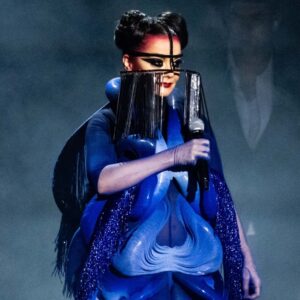
Björk performs with Rosalía on stage during The BRIT Awards 2026 at Co-op Live on February 28, 2026 in Manchester, England. (Photo by Samir Hussein/WireImage)